How is evidence actually used to combat climate change in Sub-Saharan Africa? This was the central question at a recent webinar, “Evidence-Informed Climate Adaptation Policies and Strategies: Sub-Saharan Cases,” hosted by the Evidence to Policy (E2P) Training Programme run by the Center for Rapid Evidence Synthesis (ACRES). In a showcase of the programme’s practical impact, the entire event—from moderation to expert panels—was led by mid-level learners from the Programme.
The discussion provided a rare, ground-level look at the realities of linking evidence to policy action. Featuring policymakers and researchers from Kenya and Ethiopia, the panel moved beyond theoretical frameworks to dissect the successes, challenges, and systemic gaps in building climate resilience across the continent.
The Kenyan evidence ecosystem: A blueprint for action
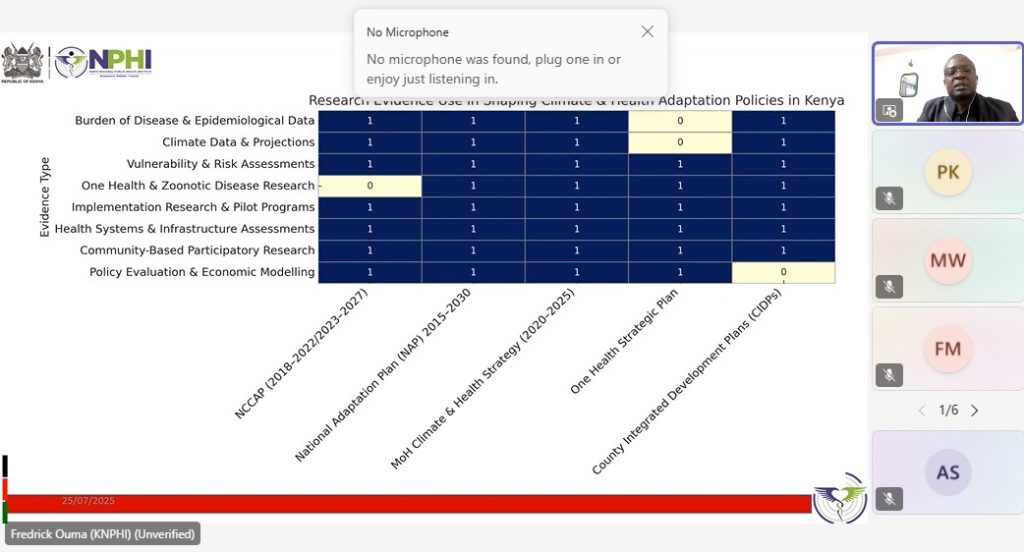
Dr. Frederick Ouma of the Kenya National Public Health Institute gave an insight on the multifaceted nature of evidence required to inform policy. He detailed an ecosystem where data from health surveillance, climate projections, and vulnerability assessments must converge to create a compelling case for action.
“The forms of evidence that seem to illustrate some sort of cause-and-effect relationship between climate and health often turn out to be among the most influential.
If a particular type of evidence directly links the impact of climate change on health, for example, epidemiological data and burden of disease like a disease outbreak during a heavy rain season, then policymaking becomes easy,” Dr Ouma said, adding “When we can show a disease outbreak map directly overlapping with flood zones, it moves from being data to a powerful story that policymakers cannot ignore.”
He outlined key sources, from routine DHIS2 health data and Kenya Malaria Indicator Surveys to collaborations with meteorological services for early warning systems. His presentation underscored a critical lesson for evidence intermediaries: the need to synthesize diverse data types to build an irrefutable narrative for change.
The implementation gap: From paper to practice
A central theme that emerged was the stark contrast between well-crafted policies and their implementation. Desalegn Yilak from Ethiopia’s Ministry of Health framed this challenge through the lens of a “multi-level implementation chain,” where national vision must be translated into local action.
“We have excellent paper-based policies, but we fail to translate them into concrete action on the ground,” Yilak noted, pinpointing the broken links in the chain.
He identified chronic issues like insufficient funding, limited technical expertise at the district level, and poor coordination between government ministries as primary culprits. His analysis highlighted the non-linear, often fragmented journey of evidence as it travels from a research report to a tangible project protecting a community.
Confronting systemic barriers: Data, finance, and focus
Dr. Fasil Mengistu from the Ethiopian Public Health Institute elevated the discussion to the systemic barriers plaguing the continent. He identified a fundamental lack of localized, long-term climate data as a primary hurdle, leaving countries to make critical decisions with incomplete information.
Furthermore, Dr. Mengistu argued that adaptation policies often suffer from a dangerously narrow focus.
“The adaptation projects are often ignoring key development issues like food insecurity and health, focusing mainly on climate change-related risks,” he explained.
This siloed approach, coupled with a severe shortage of adaptation finance, ensures that many National Adaptation Plans (NAPs) remain aspirational documents rather than operational manuals.
A testament to the E2P model
Moderated by Lisa Were of the Kenya Medical Research Institute, the webinar itself served as a demonstration of the E2P programme’s objective: to equip professionals with the confidence and competence to lead evidence-informed dialogues.
The ability of these mid-level learners to dissect complex issues, articulate challenges, and propose actionable insights speaks volumes about the programme’s impact. They are not merely learning about evidence-informed policymaking (EIPM); they are already actively practicing it on a regional stage, moving from being passive learners to authoritative voices in their field.
This discussion made it clear that the future of climate resilience in Africa depends on closing the gap between evidence and execution. It will require not just better data, but better translators—skilled professionals who can bridge the worlds of research, policy, and community action.
Watch the webinar here: https://youtu.be/p7hnAoeSmgA
0 Comments