
A Testimonial by Desalegn Ararso (MPH), Ethiopian Public Health Institute
My journey into the heart of evidence-informed decision-making began with the Evidence to Policy (E2P) Training Programme. As a public health professional at the Ethiopian Public Health Institute (EPHI), I understood the importance of evidence, but this 15-week entry-level programme transformed my understanding of how to bridge the gap between research and real-world policy.
The training, conducted by the Center for Rapid Evidence Synthesis (ACRES), blended onsite sessions in Kampala with online learning, peer networking, and dedicated mentorship. From the start, the ACRES team fostered a welcoming and open environment that encouraged discussion among participants from Uganda, Tanzania, Malawi, and my home country, Ethiopia.
The programme’s core was its hands-on approach.
We were immediately immersed in the practical process of producing a rapid review. I worked with a cross-country team on a topic I am passionate about: “Strategies for Increasing Women’s Involvement in Decision-Making and Leadership Positions, 2025.”
From framing the right question to searching, screening, appraising, and synthesizing evidence, we lived the entire process. The feedback from colleagues and mentors was invaluable, enriching our work until we finalized a report that is now under publication.
This collaborative spirit extended beyond my core team. I also contributed to another rapid review on “Challenges and Opportunities Female Entrepreneurs Face in Ethiopia, 2025” in partnership with the Knowledge Translation Division at EPHI. This was E2P in action—fostering pan-African collaboration from the ground up.
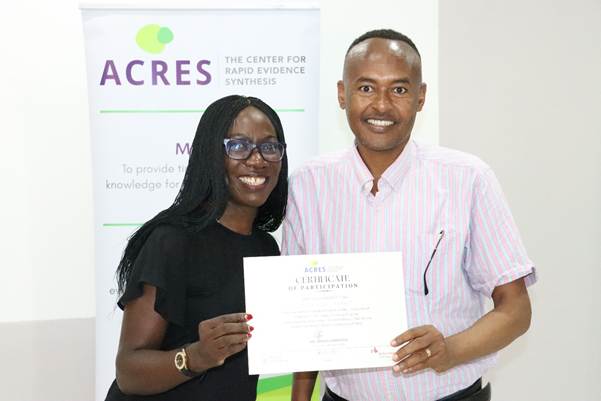
Desalegne Ararso receives his Certificate of Completion from Dr. Rhona Mijumbi, Executive Director of ACRES, marking his successful journey through the Evidence to Policy (E2P) Training Programme
Three Lessons That Reshaped My Work
The course has fundamentally influenced my approach to evidence in three key ways:
1. Communication is as Crucial as the Science. One of our facilitators from Uganda introduced us to the Johari Window model. This was a revelation. It taught me that what we communicate must not only be crystal clear to us but must also be expertly explained to become “known” to others. This “open area” is where true dissemination and impact happen. We are no longer just producing reports; we are crafting messages for understanding and action.
2. Evidence Synthesis Spans All Sectors. My previous experience was largely confined to the health sector. The E2P Training Programme opened my eyes to the power of applying these rigorous methods to social issues, education, and any development sector. The tools of evidence synthesis are universal, and their potential to inform policy across government is immense.
3. Flexibility and Collaboration are the Future. The adaptable, hands-on model practiced at ACRES is a blueprint we must follow. It demonstrates that evidence synthesis can be both rigorous and responsive to pressing policy needs.
My Vision for the Future of EIDM in Africa
The E2P programme did not just equip me with skills; it ignited a sense of responsibility. I am committed to strengthening the Evidence-Informed Decision-Making ecosystem in Africa through continued joint evidence production with my fellow African colleagues, active participation in the Africa Evidence Network (AEN), and by leading and contributing to webinars that share this knowledge.
This training has empowered me to be a more effective agent of change, ensuring that the policies shaping our continent are built on a foundation of robust, relevant, and well-communicated evidence.
Desalegn Ararso is the Division Lead for Burden of Diseases and Health Economics at the Ethiopian Public Health Institute in Addis Ababa.
0 Comments