Our Training Process Map
A transparent look at how ACRES designs, implements, and evaluates every Evidence-to-Policy training programme — from first request to final learning report.
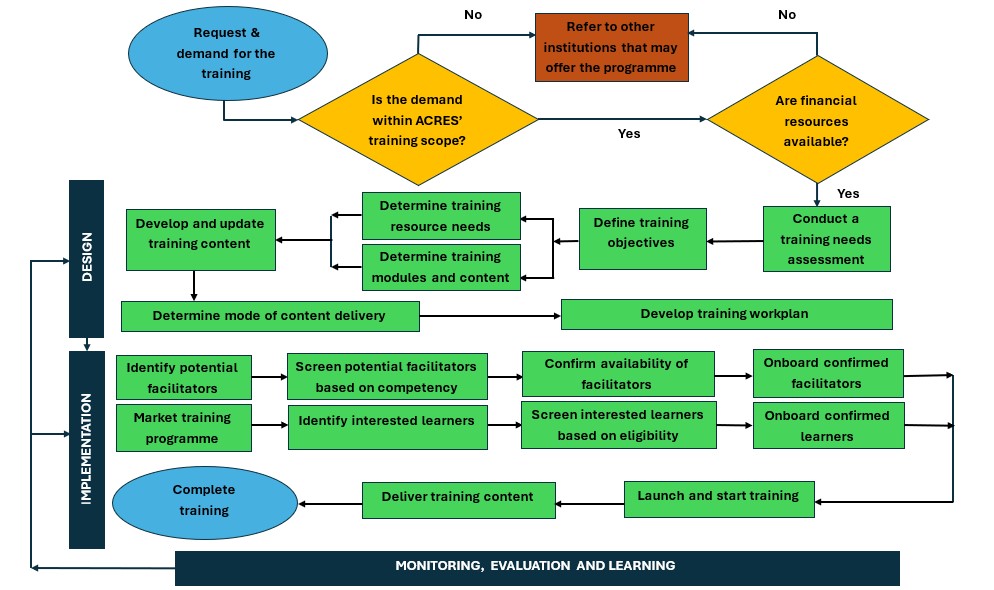
Explore the Process ↓The training cycle begins with determining programme demand and assessing whether it falls within ACRES' scope of training and resources. If valid, ACRES designs, implements, and evaluates the training programme in line with specific process requirements.
Click each phase below to expand the full description and outputs.
Programme Design
A needs assessment is conducted to inform the formulation of training objectives, resource needs are identified, and training modules, along with relevant training content, are determined. Subsequently, the training content is developed and updated, an appropriate mode of training delivery is determined, and a workplan is prepared.
Key Outputs
- Clearly defined training objectives
- A structured training curriculum
- A comprehensive workplan detailing activities, resources, timelines, and responsibilities
Programme Implementation
The training programme is marketed to identify interested learners, who are then screened against established eligibility criteria. Concurrently, potential facilitators are identified according to clearly defined competency requirements. Both eligible learners and facilitators are oriented before the training begins.
Onboarding facilitators involves providing information on programme objectives, curriculum content, training schedules, responsibilities, and training delivery methods. Onboarding learners involves providing information on programme structure, learning objectives, expectations, and learning outcomes. Learners are also guided on training schedules, materials, and participation requirements.
The training programme is then launched, and training content is delivered in a phased manner following approved training schedules.
Key Outputs
- Facilitator database (facilitators' records)
- Learner database (learners' records)
- Attendance logs
Programme Monitoring, Evaluation and Learning (MEL)
A programme monitoring and evaluation plan is developed to guide MEL activities. This includes developing a monitoring and evaluation framework, determining appropriate monitoring and evaluation tools, and specifying relevant reporting requirements.
The outputs of MEL include activity monitoring and evaluation reports, which will be used to assess the outcomes and effectiveness of the training programme. Findings, lessons, and recommendations from these reports shall inform future training programmes.
Key Outputs
- Activity monitoring and evaluation reports
- Outcome assessments and effectiveness reviews
- Findings, lessons, and recommendations for future programmes