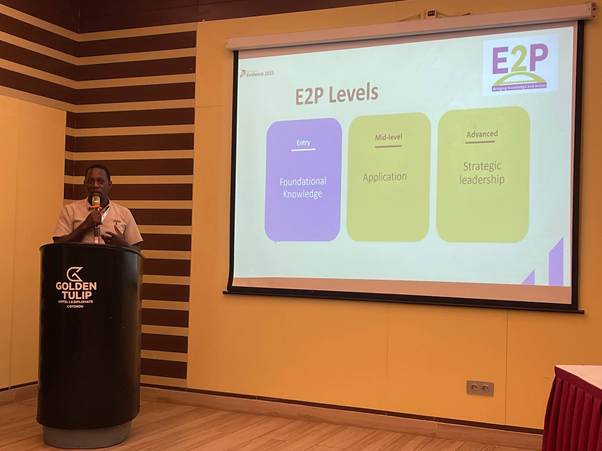
Showcasing a new model for Africa: Pastan Lusiba, Head of Capacity Building at ACRES, presents the Evidence to Policy (E2P) Training Programme at Evidence 2025 in Benin, demonstrating how we’re solving the continent’s evidence-to-policy capacity crisis through holistic, collaborative learning.
At the recent Evidence2025 summit in Cotonou, Benin, Pastan Lusiba, Head of the Capacity Development Unit at the Center for Rapid Evidence Synthesis (ACRES), presented a diagnosis of a major challenge: the persistent gap between evidence and policy across Africa is not merely an information deficit, but a capacity crisis.
For too long, efforts have focused on producing more evidence without adequately equipping the ecosystem to use it.
As Lusiba highlighted, traditional training models often fall short, failing to impart the essential relational skills, real-world contextual understanding, and continuous support systems required for sustainable impact.
This has left a landscape where valuable research frequently fails to inform the decisions that shape millions of lives.
“Existing capacity building initiatives have gaps including limited opportunities to develop relational skills at the workplace in EIP settings, inadequate preparation for real-world problems in current EIP training programs, a paucity of structures and systematic support to build competencies at the workplace, as well as insufficient follow-up and continuity in training programs to reinforce and apply the learned concepts,” Lusiba said during a panel discussion at the summit.
In direct response to this gap, ACRES designed the Evidence to Policy (E2P) Training Programme—a comprehensive, multi-level initiative that is already cultivating a new generation of evidence-informed decision-making (EIDM) leaders across Malawi, Uganda, Kenya, Tanzania, and Ethiopia.
Our approach is fundamentally different because it is intentionally holistic. We move beyond technical workshops to build three core competencies simultaneously:
Technical Competence: Mastery of evidence synthesis, critical appraisal, and application.
Cultural Competence: The ability to navigate diverse policy landscapes, power dynamics, and organizational cultures.
Collaborative Competence: The skills to build trust, facilitate dialogue, and co-create solutions between researchers, policymakers, and communities.
“A key lesson from the E2P programme’s implementation is that foundational mindsets must precede technical skills. We have learned that context is king – learning must be tailored to real-world policy dilemmas,” Lusiba noted.
For capacity building to be effective, it must act as a catalyst embedded within a larger ecosystem of support, including mentorship, peer networks, and direct opportunities to apply learning to real-world policy challenges.
0 Comments